


To Maximize . . . or Not to Maximize . . . Depreciation Deductions on your 2025 Tax Return

The deadlines for filing 2025 tax returns (or extensions) are fast approaching. Although most tax planning moves must be completed by December 31 of the tax year, there are some decisions you can make when filing your return that can save taxes now or in the future. One such decision is whether to claim accelerated depreciation breaks. Depreciation basics For assets with a useful life of more than one year, the cost generally must be depreciated over a period of years (unless accelerated depreciation breaks are available). In other words, taxpayers can deduct only a portion of the asset’s cost each year over the depreciation period. The depreciation period depends on the type of asset, ranging from three years (such as for software and small tools) to 39 years...


How the New Trump Accounts for Children Will Work

A new tax-advantaged way to help children build up savings for the future was created by the One Big Beautiful Bill Act (OBBBA): Trump Accounts (TAs). Under a pilot program, you can make an election to set up a TA for your U.S. citizen child born in 2025 through 2028 and the federal government will fund the account with $1,000 of free money. But older children also are eligible for TAs as long as they have a Social Security number and are under 18 at the end of the tax year; they just aren’t eligible for the $1,000 government contribution. Getting started One way to set up a TA is to file Form 4547, “Trump Account Election(s),” along with your 2025 federal income tax return. But the...

Treasury and IRS Provide Transitional Relief for 2025 for Businesses Reporting Car Loan Interest under OBBBA

As appearing in IR-2025-105 On 10/21/25, the Department of the Treasury and the Internal Revenue Service provided transitional guidance for businesses required to report car loan interest under the One, Big, Beautiful Bill Act (OBBBA). Notice 2025-57 provides penalty relief and guidance to certain lenders for new information reporting requirements for car loan interest received in 2025 under the OBBBA. Transition relief for 2025 Notice 2025-57 provides transitional relief for 2025 for lenders and other interest recipients who are required to file information returns with the IRS and provide statements to borrowers showing the total amount of interest received on qualified passenger vehicle loans and other information related to the loan. A qualified passenger vehicle is a car, minivan, van, SUV, pick-up truck or motorcycle, with a gross vehicle...

Payroll Tax Implications of New Tax Breaks on Tips and Overtime

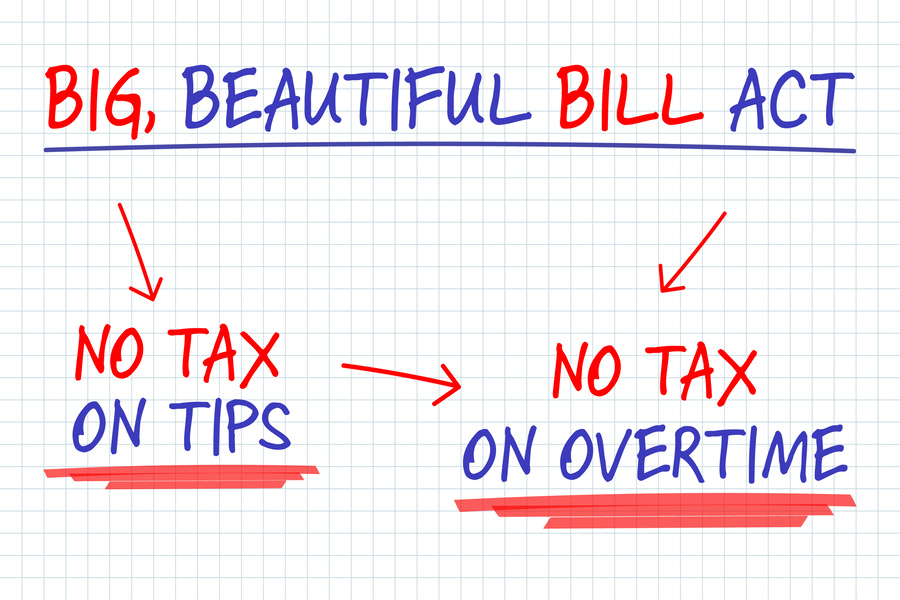
Before the One Big Beautiful Bill Act (OBBBA), tip income and overtime income were fully taxable for federal income tax purposes. The new law changes that. Tip income deduction For 2025–2028, the OBBBA creates a new temporary federal income tax deduction that can offset up to $25,000 of annual qualified tip income. It begins to phase out when modified adjusted gross income (MAGI) is more than $150,000 ($300,000 for married joint filers). The deduction is available if a worker receives qualified tips in an occupation that’s designated by the IRS as one where tips are customary. However, the U.S. Treasury Department recently released a draft list of occupations it proposes to receive the tax break and there are some surprising jobs on the list, including plumbers, electricians,...

New Rules Could Boost Your R&E Tax Savings in 2025

A major tax change is here for businesses with research and experimental (R&E) expenses. On July 4, 2025, the One Big Beautiful Bill Act (OBBBA) reinstated the immediate deduction for U.S.-based R&E expenses, reversing rules under the Tax Cuts and Jobs Act (TCJA) that required businesses to capitalize and amortize these costs over five years (15 years for research performed outside the United States). Making the most of R&E tax-saving opportunities The immediate domestic R&E expense deduction generally is available beginning with eligible 2025 expenses. It can substantially reduce your taxable income, but there are strategies you can employ to make the most of R&E tax-saving opportunities: Apply the changes retroactively. If you qualify as a small business (average annual gross receipts of $31 million or less for the last three...

IRS Lists FAQs on Expiration of Energy Credits and Deductions Under OBBBA

As appearing in IRS Fact Sheet 2025-5 These FAQs are being issued to provide general information to taxpayers and tax professionals as expeditiously as possible. Accordingly, these FAQs may not address any particular taxpayer’s specific facts and circumstances, and they may be updated or modified upon further review. Because these FAQs have not been published in the Internal Revenue Bulletin, they will not be relied on or used by the IRS to resolve a case. Similarly, if an FAQ turns out to be an inaccurate statement of the law as applied to a particular taxpayer’s case, the law will control the taxpayer’s tax liability. Nonetheless, a taxpayer who reasonably and in good faith relies on these FAQs will not be subject to a penalty that provides...

No Changes to 2025 Information Returns or Withholding Tables under OBBBA

As appears in IRS IR-2025-82 On 8/7/25, the Internal Revenue Service announced that, as part of its phased implementation of the One, Big, Beautiful Bill Act (OBBBA), there will be no changes to certain information returns or withholding tables for Tax Year (TY) 2025 related to the new law. Key points for TY 2025 relating to OBBBA provisions: Form W-2, existing Forms 1099, and Form 941 and other payroll return forms will remain unchanged for TY 2025. Federal income tax withholding tables will not be updated for these provisions for TY 2025. Employers and payroll providers should continue using current procedures for reporting and withholding. . These decisions are intended to avoid disruptions during the tax filing season and to give the IRS, business and tax professionals enough time...

OBBBA 2025: Tax Deductions for Working Americans and Seniors

As appearing in IRS Fact Sheet FS-2025-03 Below are descriptions of new provisions from the One Big Beautiful Bill Act, signed into law on July 4, 2025, as Public Law 119-21, that go into effect for 2025. “No Tax on Tips” New Deduction Effective for 2025 through 2028, employees and self-employed individuals may deduct qualified tips received in occupations that are listed by the IRS as customarily and regularly receiving tips on or before December 31, 2024, and that are reported on a Form W-2, Form 1099, or other specified statement furnished to the individual or reported directly by the individual on Form 4137. “Qualified tips” are voluntary cash or charged tips received from customers or through tip sharing. Maximum annual deduction is $25,000; for self-employed, deduction may not...

Bullet Point OBBBA Changes Impacting Individuals

The One Big Beautiful Bill Act (OBBBA) was signed into law on July 4, 2025. The Act is comprehensive and includes key changes to individual-related provisions and incentives. Navigating these changes will be complex, but understanding them is essential for effective tax planning and optimizing your position.  The following is a list, not intended to be all-inclusive, which highlights some of the major provisions impacting individuals. Reduced Income Tax Rates: The Act makes permanent the lower individual income tax rates and wider tax brackets introduced by the Tax Cuts and Jobs Act (TCJA), preventing a scheduled tax-rate increase after 2025. For example, the top individual rate will remain at 37% (instead of reverting to 39.6%), and the marriage penalty relief for most brackets continues. This...

Bullet Point OBBBA Changes Impacting Businesses

The One Big Beautiful Bill Act (OBBBA) was signed into law on July 4, 2025. The Act is comprehensive and includes key changes to business-related provisions and incentives. Navigating these changes will be complex, but understanding them is essential for effective tax planning and optimizing your position.  The following is a list, not intended to be all-inclusive, which highlights some of the major provisions impacting businesses. Qualified Business Income (QBI) deduction: The Act makes this deduction permanent. It also sets a minimum deduction for active QBI for “applicable taxpayers” at $400; defines an applicable taxpayer as one whose aggregate QBI for all active qualified trades or businesses for the tax year is at least $1,000; and establishes inflation adjustments for the new minimums starting in...