


Superior Results. Delivered.
Blog

Can You Recycle a Business Valuation Report?
If you’ve previously obtained a formal business valuation, you might be tempted to reuse it for another purpose. This might seem like a good way to save time and money. But doing so without first determining whether the report and its conclusions are appropriate for the new use can create significant risks. Timing issues Think [...]
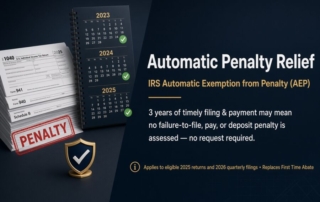
Eligible Taxpayers May Receive Penalty Relief Automatically
As appearing in IRS Tax Tip 2026-59 Taxpayers with a history of filing and paying on time may now have an easier path to receive penalty relief. This summer, the IRS’s new Automatic Exemption from Penalty or AEP will replace the long-standing First Time Abate administrative relief. AEP is designed to eliminate the need to [...]

Disability Benefits May Have Income Tax Consequences You Don’t Expect
Disability insurance is a valuable benefit provided by many employers. It replaces a portion of the insured person’s income — typically 45% to 65% of pre-disability earnings — after a specified waiting period that starts when the person becomes disabled (as defined by the policy’s terms). Whether you’re just beginning to receive disability benefits or you’re [...]

Tax Essentials for Sole Proprietors
Many small businesses start out as sole proprietorships. This structure is simple and inexpensive to establish and maintain — and it gives the owner direct access to profits without having to take formal distributions. But it also makes your taxes more complicated than when you were a W-2 employee. Here are some federal tax issues [...]

Is Fraud Lurking in Your Accounts Receivable Department?
Your business depends on consistent cash flow, making accounts receivable one of its most important assets. Unfortunately, this asset is also a frequent target of dishonest employees because the process of receiving and recording payments can create opportunities for theft if proper safeguards aren’t in place. Regularly reviewing receivables processes and confirming that employees follow [...]

Tax Tips for Parents with Kids in College This Fall
A higher education is expensive, and many parents spend years saving up. Others haven’t had the financial bandwidth to save or have hit unexpected financial roadblocks along the way. Regardless of your situation, current tax breaks may be available to you (or to your children or even their grandparents) once your child begins attending college [...]

Hiring a Valuation Advisor to Support Your Business Interruption Claim
Business interruption insurance may replace lost income and reimburse certain continuing expenses after a covered event damages property and disrupts normal operations. If a fire, storm or other disaster strikes, a business valuation professional can help you quantify the financial impact and prepare a well-documented claim. Covered events Business interruption insurance is arguably one of [...]

Could the New Markets Tax Credit Benefit Your Business?
Businesses in economically distressed communities often have difficulty obtaining capital for expansion, equipment, facilities and other investments. The New Markets Tax Credit (NMTC) encourages private investment in these underserved areas by offering federal income tax credits to qualifying investors. This credit was previously scheduled to expire on December 31, 2025. However, the One Big Beautiful [...]

Be Tax-Smart with your Mutual Fund Investments
Mutual funds offer an easy way to invest in a diversified portfolio compared to buying individual stocks and bonds. But the tax treatment of mutual funds isn’t so simple. How are mutual funds taxed? If you sell appreciated mutual fund shares, the resulting profit will be taxable. If you’ve held the shares for one year [...]

Back to Basics: 8 Anti-Fraud Controls to Help Keep Operations Running Smoothly
Fraud prevention doesn’t always require large expenditures or sophisticated technology. More often, it comes down to simple controls that address common fraud vulnerabilities. Many banks offer tools that can strengthen payment controls, but businesses must make sure the tools are properly activated and consistently used. Other safeguards depend on well-designed internal procedures and employee compliance. [...]

When an Employee’s Form W-4 Raises Red Flags
Your employees use Form W-4, “Employee’s Withholding Certificate,” to tell you how much federal income tax to withhold from their pay. Most forms are routine, but an altered certificate, unusual accompanying statement or IRS lock-in letter may require special handling. Knowing how to respond can help your business meet its withholding obligations without becoming involved [...]

How WHAT you Donate Impacts your Tax Deductions
Have you already made contributions to charity this year? Are you considering making more between now and year end? If so, it’s important to be familiar with the tax rules for different types of donations so you can maximize your tax benefit — or at least avoid finding out at tax filing time that your [...]

Using the Asset Approach to Value a Business
Business valuation professionals use three approaches to determine the fair market value of a business or business interest. First, the income approach derives value from the business’s future earnings. Second, the market approach relies on comparable business transactions to estimate value. And last, but not least, the asset (or cost) approach converts the book values reported [...]

The New-and-Improved Credit for Employer-Provided Child Care
Offering a broad menu of employee benefits can help your business attract and retain skilled workers. One benefit that’s popular among employees with families is employer-provided child care. Although this option hasn’t been financially feasible for many small businesses, recent tax law changes may give you a reason to reconsider opening (or upgrading) a child [...]

Before Your Spend Lottery, Gambling or Other Winnings, Understand the Tax Rules
It’s easy to focus on the excitement of a big win. But federal tax law generally treats lottery prizes, gambling winnings and other awards as taxable income. Knowing the basic rules can help you avoid surprises when you file your 2026 return next year. Lottery prizes Of course, the chances of winning big in the [...]
Disclaimer
This blog is designed to provide competent and reliable information regarding the subject matter covered. However, it is being provided with the understanding that the blogmaster is not engaged in rendering investment advice. Laws and practices often vary from state to state and if investment assistance is required, the services of a licensed investment professional should be sought. The blogmaster resolutely encourages the reader/viewer to do their own research and due diligence before acting on any information contained herein. As such, Roger Rossmeisl specifically disclaims any liability that is incurred from the use or application of the contents of this blog. It should also be noted that the views contained in this blog are not necessarily representative of the opinions/beliefs of the other owners, management and/or employees of Kho & Patel CPAs.


